Lecture Quantum Information and Computation (Winter 2024/25)
| Type: | Lecture with Exercises |
|---|---|
| Programs: | BSc CS, ITS, Math, Physics, ETIT, MSc CS, ITS, AI, Math, Physics, ETIT, and CASA PhD Lecture |
| Lecturer: | Michael Walter |
| Time and Place: |
Lectures: Thu 16-18 (MC 1.30+31) Exercises: Mon 14-16 (MC 1.30) and Tue 12-14 (MC 1.30) |
| First meeting: | Oct 10 |
| Credits: | 5 CP |
| Contact time: | 2+2 SWS |
| Language: | English |
| Course number: | 212011 |
| Links: | Moodle, VVZ |
Interested in this course?
- If you plan on participating in this course, please kindly sign up on Moodle so that we have an overview of how many people will show up. There, you can also see the latest version of the lecture notes.
- Interested in a sneak peek at some more of the teaching material? Have a look at last year’s Moodle course.
- Already took our two lecture courses? If so, you might be rather interested in our seminar!
- Any other questions, scheduling conflicts, etc? Feel free to contact us.
Course Description & Syllabus
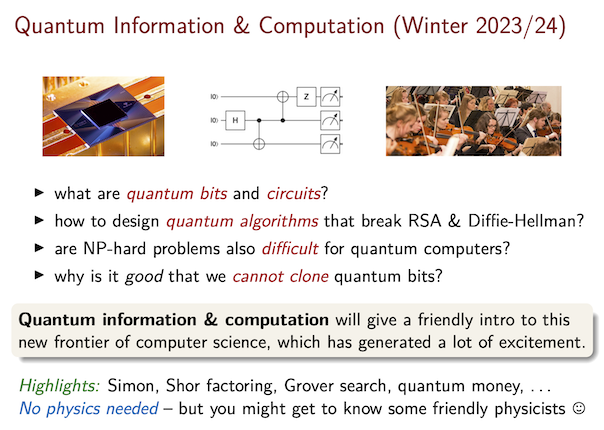
This course will give an introduction to quantum information and quantum computation from the perspective of theoretical computer science. We will discuss the theoretical model of quantum bits and circuits, how to generalize computer science concepts to the quantum setting, how to design and analyze quantum algorithms and protocols for a variety of computational problems, and how to prove complexity theoretic lower bounds.
Topics to be covered:
- Fundamentals of quantum computing: from classical to quantum bits, states and operations
- Quantum circuit model of computation
- Quantum computing with oracles: Deutsch-Jozsa, Bernstein-Vazirani, Simon
- Hadamards, quantum Fourier transform, quantum phase estimation
- Shor’s quantum algorithms for discrete logs and factoring
- Grover’s search algorithm and beyond: how to solve SAT on a quantum computer?
- Quantum query complexity
- Quantum entanglement as a resource: superdense coding and teleportation
- From “no cloning” to quantum money: a peek at quantum cryptography
- Nonlocal games and CHSH game
This course should be of interest to students of computer science, mathematics, physics, and related disciplines. Students interested in a Bachelor’s project in quantum information, computing, cryptography, etc are particularly encouraged to participate.
Recommended prior knowledge
Familiarity with linear algebra, discrete probability, and theoretical computer science, each at the level of a first BSc course; we will briefly remind you of the more difficult bits in class. Some experience with precise mathematical statements and rigorous proofs (since we’ll see many of those in the course). No background in physics is required.
Material & Literature
Please find a recent version of the lecture notes on Moodle. Video recordings of the lectures are also provided.
In addition, the following references can be useful for supplementary reading (the first one in particular served as inspiration for this course):
- O’Donnell, Quantum Computation and Quantum Information, course material available online (2018)
- Mermin, Quantum Computer Science, Cambridge University Press (2007)
- Nielsen and Chuang, Quantum Computation and Quantum Information, Cambridge University Press (2010)
- de Wolf, Quantum Computing: Lecture Notes, available online (2022)
Learning outcomes
You will learn fundamental concepts, algorithms, and results in quantum information and computation. After successful completion of this course, you will know the theoretical model of quantum information and computation, how to generalize computer science concepts to the quantum setting, how to design and analyze quantum algorithms and protocols for a variety of computational problems, and how to prove complexity theoretic lower bounds. You will be prepared for an advanced course or a BSc project in this area.
Grades and homework
Please see Moodle.
← Back